Sunday, July 19, 2015

Summer park time

At the Parc des Buttes Chaumont.
 The hilliness and bridges and water features make me feel at home.

Near Rue des Rosiers, an interesting vehicle on the street. Various bits spun as the entire metal contraption got pedalled, laboriously, up the street.


This post's theme word is pavonine, "of or resembling a peacock; vain, showy." The pavonine tricycle is rather impractical.

Saturday, July 18, 2015

Eiffel view

Every once in awhile, you turn a corner, and... there it is!

That tower, the sunlight, a lovely day. Wonderful city.


This post's theme word is oenophile, "someone who enjoys wine." (EE-nuh-fyl) What is that in the distance? Aaaaah, welcome to the land of oenophiles!

Tuesday, July 14, 2015

Concise naming conventions

Can you spot the odd one out?
Naming conventions are fun. Usually the target is simplicity and information... sometimes the target is the entire story. I'm left wanting more: why did he hang his robe? Did it dry? Did he come pick it up later?


This post's theme word is usufruct, "the right to use and enjoy another's property without destroying it." Walking the castle's grounds is an usufruct often exploited by tourists.

Food round-up: onigiri, etc.

Never have I ever felt my kanji dearth more strongly than when confronted with food choices.
On the other hand, how can you go wrong when confronted with a wall of onigiri?


This post's theme word (via page 297 of Miéville's Kraken) is sybarite, "a person devoted to luxury or pleasure." Behold, the sybarite's fridge!

... burned down, fell over, THEN sank into the swamp...

The fire brigades and construction squads just could not catch a break with Osaka Castle.
"The center of the castle is called Hommaru and in the case of Osaka Castle, the government palace was situated in Hommaru. The palace built in the Toyotomi period was burned down in 1615 during the Summer War of Osaka. Later the Tokugawa Shogunate rebuilt the castle together with the palace but again it was burned to ashes in 1868 during the civil wars of the Meiji Restoration. In 1885 a part of the palace in Wakayama Castel was moved to this place and was called Kishu-Goten Mansion but this mansion too was burned down in 1847."

The castle grounds are a huge nested set of walled and moated compounds, and it was not particularly clear which pieces had burned down when, although some very involved infographic maps attempted to portray it. This is not helped by the fact that the entire zone shifted, grew and shrank, over the course of these several hundred fire-swept years.

This plaque --- freestanding in an open area --- also notably does not describe when, or by whom, any of the currently-standing structures (mostly stone) were built. I remain clueless, but delighted. I do not think that a Western cultural location would ever have such a frank and unabated listing of the various destructions the area had suffered. And the details! Not simply burned, but burned to ashes, a complete obliteration into tiny constituent particles and released energy.


This post's theme word is adjure, "to command solemnly," or "to request earnestly." The shogun adjured that the castle be rebuilt --- this time, of fireproof stone.

Monday, July 13, 2015

Not a crêpe, but trying

The crêpe is a thin sort of griddle-roasted pancake, often folded around a filling (fruit + nutella or savory food + nutella or just nutella or super-nutella + nutella), associated with France. Note the accent placement, and that filling a warm crêpe with a frozen material is heresy.

Now consult this photo. Can you spot any problems?
Far be it from me to condemn cultural reappropriation, but... I think what this sign means is is: ice cream cone. Shaped out of a thin pancake, I guess? Bizarre. But the cones were... well, conical. Also, filled with ice cream. And the accent is some strangeness never before seen by these widely-travelled and linguistically-versed eyes. The cooking setup was missing the usual crêpe griddle and tiny spreading-spatula, too. Everything about this was familiar, but just weird enough to feel uncomfortable.

I'm not sure how this confusion happened. Crepes are horizontal; cones are vertical; never the twain shall meet. I stand firm on this point. I walked away from "Grampa's Cŕepes" and instead bought a tiny hot pastry on a stick, shaped like a fish, which turned out to contain molten mouth-burning red bean paste. As of publication, the name of this delicacy remains unknown; I ordered by politely asking for "one of those."


This post's theme word is alterity, "the fact or state of being other or different," diversity, difference (brought to you by Miéville's Kraken, pg 299). The crêpe alterity fomented a cognitive dissonance familiar to the stranger in this strange land.

The stereotypical alley

This is essentially a piece of the world which has been fully realized to the specs of a William Gibson novel.
It is simply the most stereotypical Japanese late-night mostly-pedestrian food-, electronics-, and entertainment-alley that could instantiate the vertical neon writing necessary for the mood. And (apparently) for the general illumination of the area.

Photo taken minutes after sundown, but auto-light-adjustment lightened it to seem like a pervasively blue/purple sky. Human eyes saw it as entirely dark, with neon ground accents in the human areas. (At least, that is what humans reported to me.)

The neon light was a visually interesting texture, especially since so many surfaces were flat planes or reflective water. The city is so clean well-maintained that it looks almost rendered. If it were not for the oppressive heat/humidity combination, it would be quite lovely.


This post's theme word is perse, "of a greyish blue or purple color." The sky spread above the cityscape, a thick perse palette scraped across the firmament.

Mirabelle pie

Not really on-schedule for π day (and in any case, the food/mathematical constant homonym doesn't work in French), but every day is a good day to make pie.
This photo shows 80% of my entire kitchen space, and was taken standing in the dining room space.
This one was an experiment with mirabelles, a type of yellow plum I had never heard of. I followed a recipe which instructed me to make a custard to fill the interstices between the mirabelles. It worked.


This post's theme word is cunctator, "one who hesitates, a procrastinator, a delayer." The cunctator celebrated Pi Day in July.

The texture of water

Sometimes a visual experience will tingle my brain so pleasantly that I pause to take a photo. Possibly to remember the experience, or capture an echo of it, or try to recreate it in some small way at a remove of time, location, and all other sensory information.

Here is some lovely surface-of-water texture from a canal in Osaka:
The opacity of the water (sediment?) made the entire thing look like a smooth piece of jade, darkening in the shadow under a foot bridge.

In the open sunlight, and with some natural elements visible, here is a segment of the pond around this temple in Kyoto.
Turtles furtively bobbed their heads above the surface, in the reeds, hiding from tourists but delighting the children patient or bored enough to be looking in the right place for just a fraction of a second.


This post's theme word is jargoon, "a colorless, pale yellow, or smoky variety of zircon." The runoff inlet resembled jargoon in monsoon season.

Sunday, July 12, 2015

Skyscraper portraiture

Kyoto is many things: magnificently large, magnificently crowded, magnificently hot, magnificently humid. And magnificently skyscrapered.
Especially centered around the many-lobed shopping mall/hotel/William-Gibson-novel-city connected to the Kyoto train station, the skyscrapers are numerous. I think they may be infinite, spawning by running stolons along, just under the sidewalk.
The boundary between interior and exterior is in some places sharply defined, with solid mirrored slabs, and elsewhere porous, with open enclosed spaces and revolving doors in sequences of airlocks to keep the air conditioning inside and the oppressive heat outside.
It is possible to climb up to the roof of several skyscrapers.
I did this to give myself some goals whose intermediate steps all involved staying indoors, in climate control, shielded from the oppressive day-star.
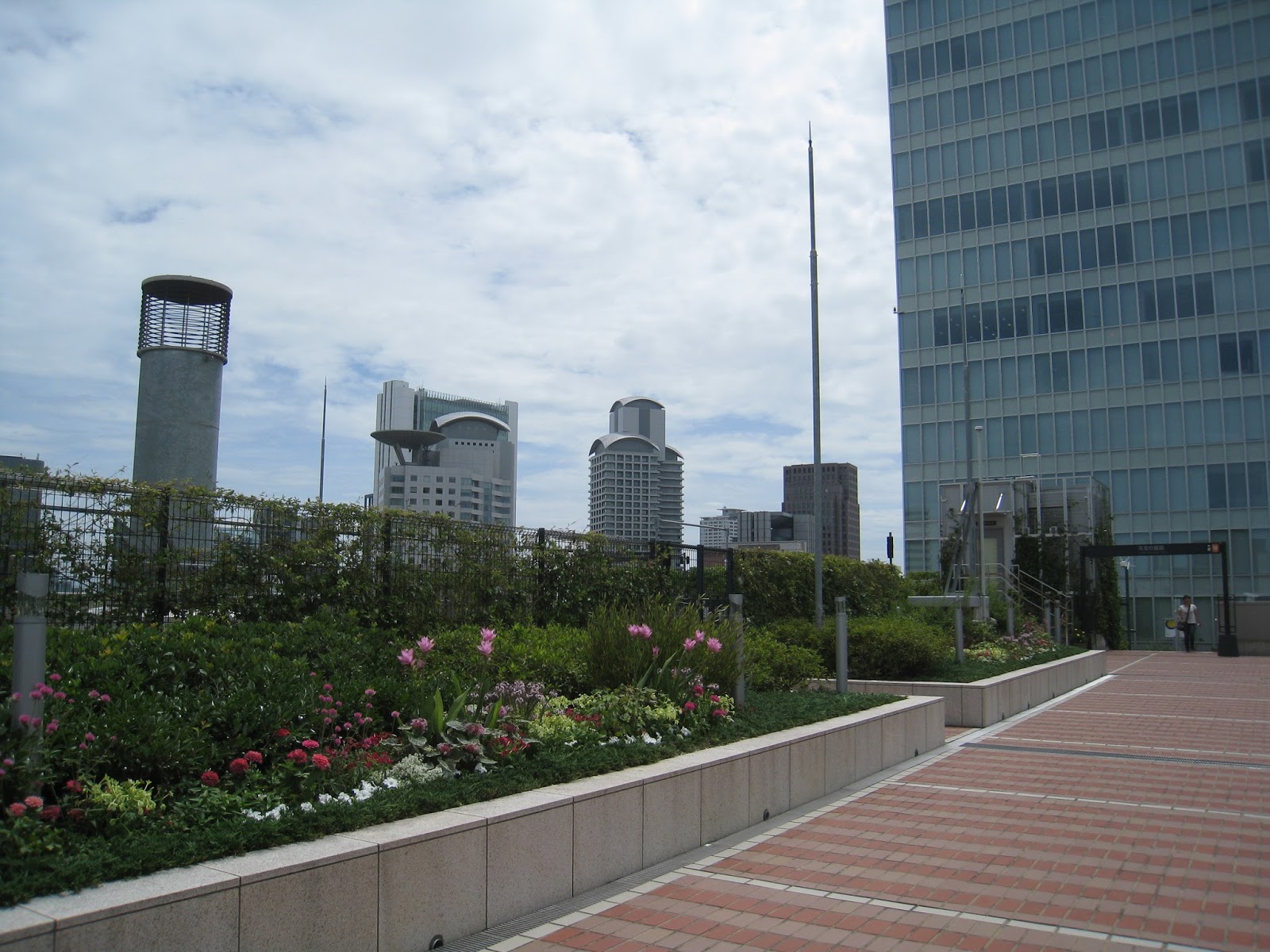
But the roofs were dramatic. It's a view that cannot be had from the hot, humid, crowded ground, where other humans, and trains, and buses, and the buildings themselves, prevent a wider survey of the city.
This roof had a community garden, a touch which was quaint and adorable. The garden must be visited by millions of tourists a year (taking exactly the photos I took), but was completely unmolested. The signs requesting that we not stand in the flower beds (to take better photos) were, miraculously, respected: this is Japan. It's hot and humid, and rice paddies are visible between low-slung residential buildings, but somehow it is still an enormous urban center.

Fun.


This post's theme word is purlieu, "a neighboring area," or "a place that one frequents or has control." The skyscrapers' purlieu featured gardens, castles, and (mostly) other skyscrapers.