Tuesday, March 22, 2016

Iolanta / The Nutcracker

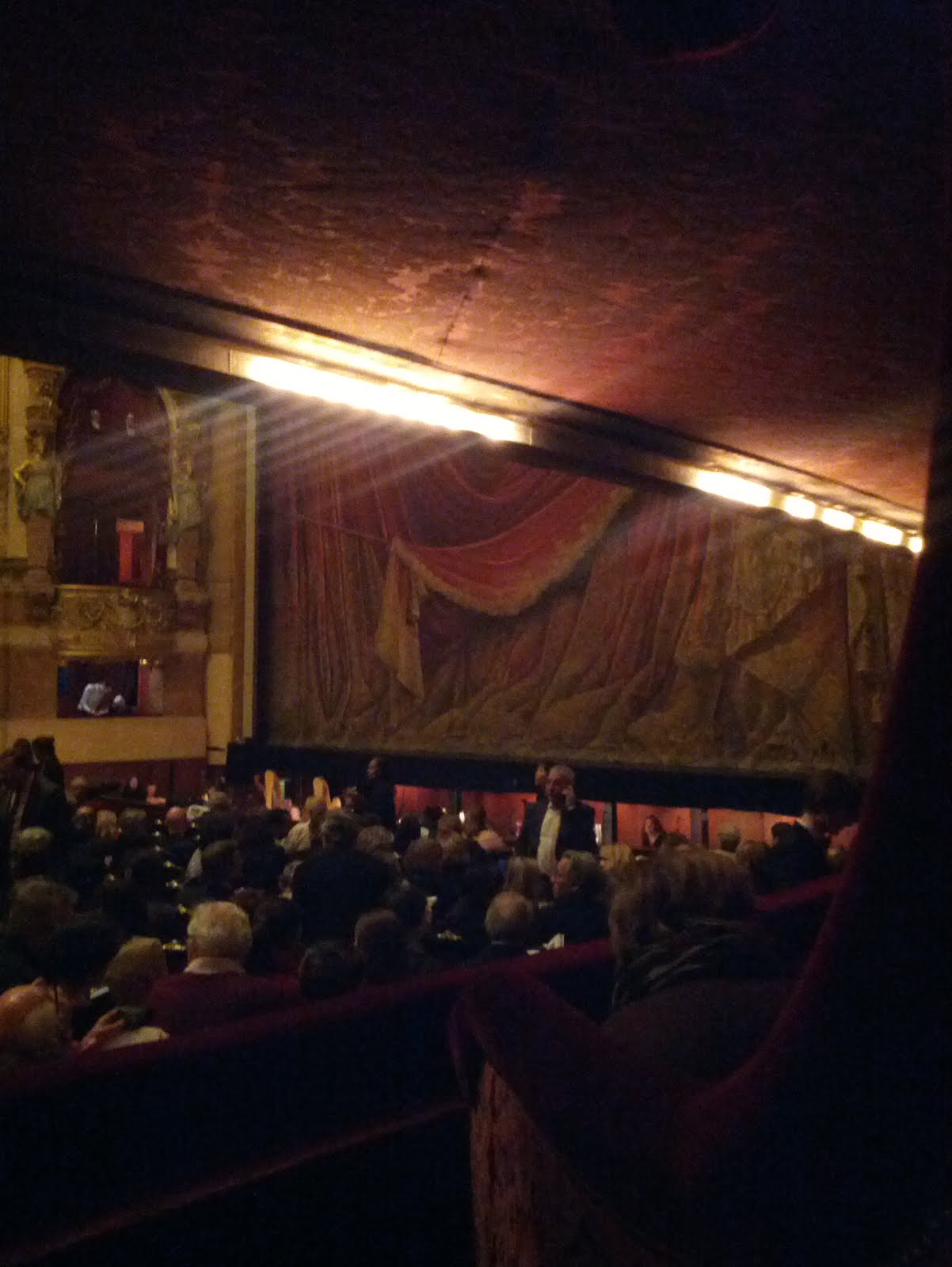
The Palace Garnier is a beautiful building, ornate and baroque and frankly luscious inside. (See previous shots of the lobby.) The performance hall is just as sumptuous, with tiers of box-lined balconies and everything done in red velvet and gold.
The boxes look nice, and as you can see, they serve as wonderful vantage points for looking at the other boxes. The stage? Not so much.
The neighbor-box dividing wall --- lined in red and buffering me from the lower classes who were presumably permitted into the lesser boxes --- blocks one corner of the stage. The overhanging lip of the next tier blocks the upper third of the area, including the opera titles. Not pictured here, but the people sitting in front of me, as they variously shift and lean to try to see the stage, blocked even more.

So the visual part of the spectacle was difficult.

Luckily, the Opéra Garnier production of Tchaikovsky's Iolanta used only an inset, centered portion of the stage. I read the synopsis beforehand, so the omission of the opera titles (and my weakness in Russian) did not impede my enjoyment of the music and singing. It was lovely, one completely standard and satisfactory unit of opera enjoyment. So of course I have almost nothing to say about it, and lots to say about the rest of the evening.

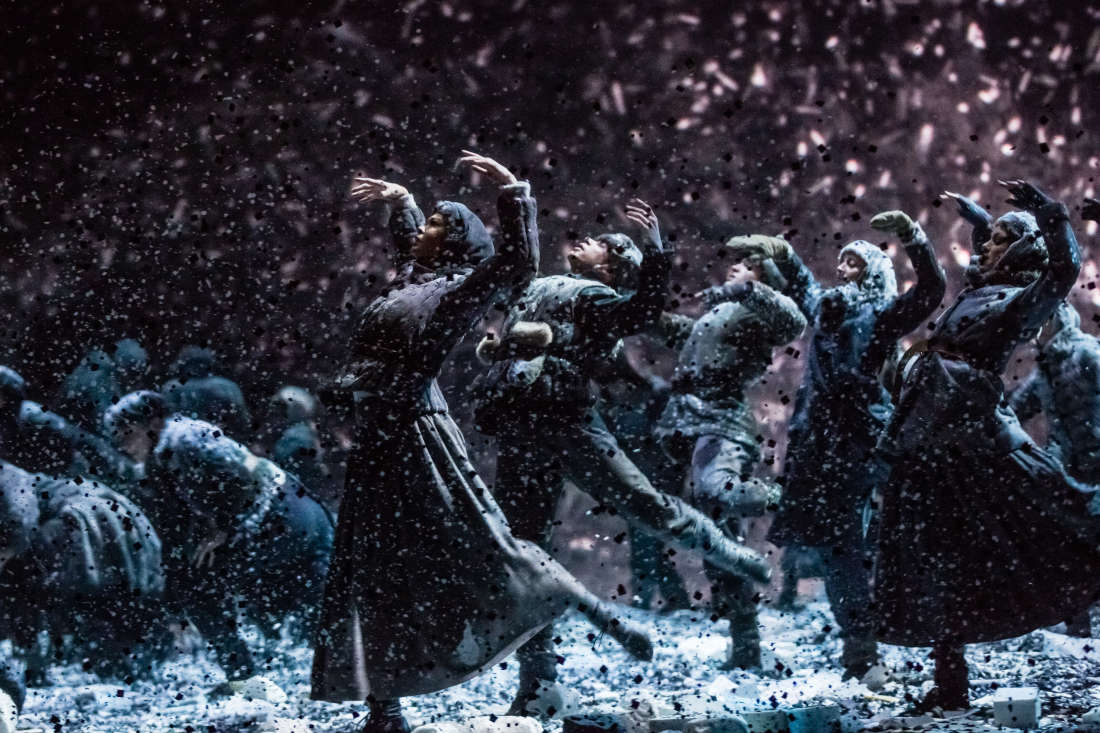
Following the opera, the ballet performed The Nutcracker, in a non-Christmas-themed staging that I wasn't able to cohere into a single plot. The various scenes were only loosely connected, via interesting stagecraft. The single-room set in which Iolanta took place drew back and slotted into a larger set which filled the stage, where The Nutcracker began as a 1920s-themed children's birthday party. (Of note: Iolanta had a Christmas tree onstage, which was removed for The Nutcracker, in some kind of reverse-Chekov's-gun/red herring ploy.) This included a very cool game of improvised freeze-tag synchronized with the music. Ballet companies should play freeze tag in public more often, it is really fun to watch. This scene ended with a harsh exploding noise, and the building apparently (?) succumbed to an earthquake, with rubble (!) falling from everywhere and blanketing the stage. A transparent screen completely divided the stage from the theater, so no rubble or its considerable dust settled on the orchestra or audience. The pas de deux was staged as two survivors of this earthquake. (I think. A lot of it took place on the occluded side of the stage.) Then, in my favorite use of the screen-wall, giant fans gusted snow all across the stage to its full height, like a blizzard. Heavily wool-jacket-bundled ballet dancers did a kind of freezing coordinated squall dance that was interesting, and not really like other ballet I've seen. 
Ballet in a snowstorm.
Check out the gallery for more, and to get an idea of the variety of spectacle presented across the evening.


This post's theme word is furfuraceous, "covered in dandruff" or "flaky". I do not envy the scene-changers their furfuraceous task during the second intermission.

Monday, March 21, 2016

Chocolate window display season

The seasons are observed here primarily by fashionable footwear and window displays. We are now solidly into the "absurdities constructed of chocolate" season. (Previously.) The displays either fall into the "embarrassing abundance of chocolate riches" camp:
Everything can be chocolatized: snowmen, chickens, bunnies, eggs, n'importe quoi (simply everything).
... or the "stark and dark but decidedly sumptuous" camp.
Vaguely religious, for those who worship hollow animals made of chocolate.
The displays are delightful.
Hundreds of euros' worth of exquisite chocolates.
I cannot find anywhere --- not even the British specialties importer* --- who has Cadbury minieggs. The European-brand substitute is not the same, does not elicit the taste-memories of late-night problem sets and slogging through slushy snow. I gaze upon a wealth of taste, and miss my lowbrow origins.

This post's theme word is suasion, "the act of urging; persuasion." The particular arrangement on display was the final suasion tempting me into the shop of earthly delights.


*An inexplicable business, here in the heart of France, which imports bland dried and canned food from the UK, and somehow stays open. I admit I patronize them for the oatcakes, so I am supporting the import of inexplicable gustatory horrors into the land of wine, cheese, and bread.

Wednesday, March 16, 2016

Cleave

After enjoying the trilogy's first book and disliking the second, I popped from the top of my book-stack the third one: Elizabeth Bear's Cleave. At first, it was just to see if my new contact prescription was comfortable for reading, but the book managed to sustain my interest, and at the boring or frustrating parts I just soldiered on and through. Now I have finished the trilogy, and it can drag at my heels no longer.

The coolest part by far, and the part that made me hang on until the end, was the moment when two groups of humans meet each other, and find that they are far more mutually alien than the several actual forms of alien life that they have separately encountered. It's a nice moment, the climax gently engineered for many chapters before, and it gave me a little reader-frission.

The fantasy technology to upload whole minds, and thus have machine-mediated memories and brain functioning, was exploited (but only when it served the plot, and not when it would have shortcutted the plot). This allowed a lovely moment of clarity by one character:
I've got a head so full of dead people I suspect whoever I started off as should probably be counted as one of them. (p. 131)
Lots of things gave me ε increments towards rage-quitting, but they never quite triggered book-abandonment. The sentences in general, their constructions and tendency towards Latinate words and local jargon, did not render the book a pleasant poetic read. It read more like my own train of thoughts: technically correct, with all manner of dependent clauses tacked anywhere they'll stick, reveling in complicated words and light wordplay, but coming across as bloodless. It's fine when it's in my own head --- that's me, I can't escape it --- but choosing to spend my leisure time immersed in this verbal frippery was not the relaxing joy that I seek in reading. And the completely unpredictable plot "twists", each of them a new technology/philosophy that could resolve the entire plot (and yet somehow didn't), detracted from the books' good features and distracted me. Most of the two-person dialogues were pure sophistry, barely internally consistent, and immediately invalidated by the next plot hook.

The end of the novel, and trilogy entire, was just as frustrating as the entirety of book two, with all of the meaty interpersonal conflicts and the intellectually interesting problems and the culture shock completely obliterated by a deus ex machina that, in retrospect, could have taken place on the first page of the first book and obviated the need for all these words, words, words.


This post's theme word is covert, "a feather covering the base of a main flight or tail feather of a bird." The covert down, with restricted availability and only obtainable by sneaking, is the softest and most prized for winter jackets and blankets.

Monday, March 14, 2016

Pi(e) day (observed)

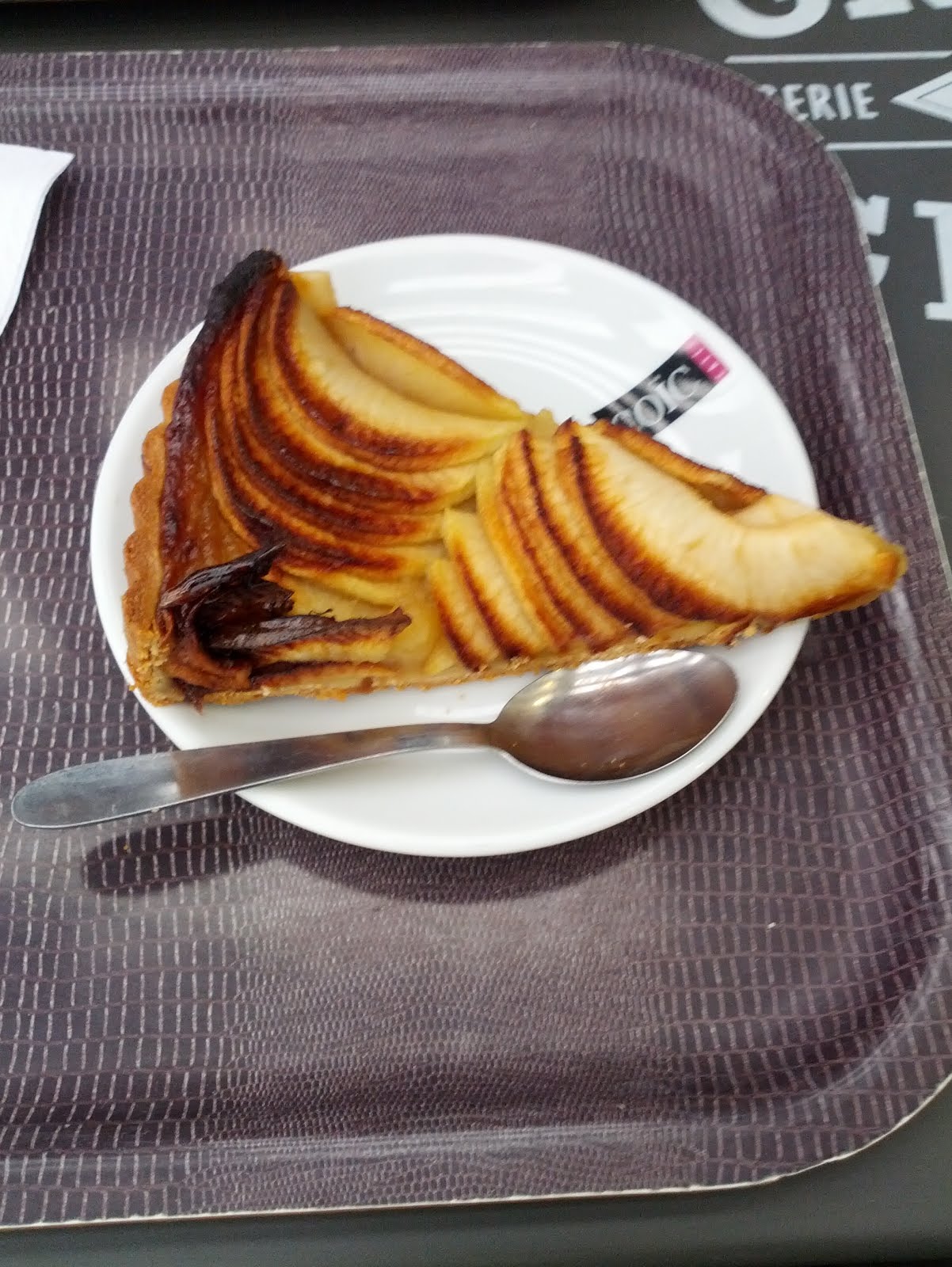
Certain calendrical conventions mean that today is not any particular day. But on the other side of a large body of water, there's a continent where dates are written hodgepodge, in no significant order. In recognition of this dubious date mismatch, I ventured forth and had a piece of pie.

This post's theme word is nugacity, "triviality, futility." The nugacity of the approximation does not dull the palate's enjoyment!

One year with a food scale and a spreadsheet

Let's take a brief jaunt into one of my most active spreadsheets: the one that tracks my macronutrients (consumed), exercise (performed), and weight (mass * gravity). I now have about a year of data, so perhaps we can see some trends.

The motive for the spreadsheet --- and the food scale which enabled me to precisely measure my food, for cooking, eating, and tracking purposes --- was mostly curiosity, an enjoyment of data points, and the interest to see if there were any long-term changes that were too gradual to notice on a daily basis.

Here's the chart, minus all labels because I don't have infinite time to wrestle with chart software to make something nice-looking, and also I don't have the expertise for what features a good chart should have.

X-axis: days in the past year (some data incomplete on some days)
Y-axis blue: kilocalories consumed (centerline is daily recommendation)
Y-axis green: exercise (goes from slothlike 0 at bottom to outrageously exhausting LAC day at top)
Y-axis red: mass ("normal" BMI cutoff is bottom 1/8 of scale; the rest is "overweight"; total span is ~6kg)
Obviously these clusters of blue/green/red dots are not super-easy to read. I have made your chart-reading life more difficult by stripping off all labels on the axes, for my own private reasons. It might help to interpolate some trendlines. Here are linear interpolations.
With linear trendlines, it looks like mass tends towards 0.
At various intermediate exponents between 2 and 10, the best-fit polynomials have weird corners or predict extreme blowup/decreases outside the range. This seems like a bad fit because my weight will probably not plummet to 0 in the next few years, and my exercise did not start at 8x my current effort just before the data began.

Here are some 10th-degree polynomial interpolations (below). I picked 10 because that was the highest available, and I have no idea what sort of trendline I should be picking to get a "meaningful" trend (visually interesting, useful, predictive). Notice that these polynomials predict crazy extremes --- my weight before the data was enormous, and my future weight is smoothly tapering down. I have fun watching how the best-fit polynomial changes when I add a new data point, as the relative flatness of the data means that it sometimes wiggles in an aesthetically pleasing way to accommodate the new point.
With degree 10 polynomial trendlines, the downtick in mass echoes the uptick in exercise.

This is not groundbreaking data analysis. Clearly. But I do enjoy playing with a spreadsheet.

Some very plain observations:
  • kCals: I eat approximately the daily recommended kCals, with some reasonable variation. A few of the really low outlier days I had a bad cold or food poisoning. The high outlier days I was just hungrier, so I ate more. Some of the really high outlier days are missing, as I definitely ate more on vacation in BBQ-feasting Texas, but I didn't reliably measure those days and didn't worry about it.
  • exercise: I'm using Fitocracy to turn my various workouts into a single number. Sometimes the number seems much too low/high compared to how much effort I felt the workout required. But at least it's a standardized measure.
    The trendline is helpful here because in any given week, hard workouts are mixed in with easy ones, so probably the average is more enlightening than the actual individual data points. (The chart has all that empty space at the top because high-outlier workout days occur at regular intervals, once or twice a week, and I wanted to visually include them in the chart.)
    The recent uptick in exercise reflects the fact that I have been going climbing once a week, regularly replacing a low-scoring easy workout with a high-scoring hard one. It's nice that the trendline shows this.
  • weight: I lost some, but if you look at the data points you'll see that my daily weight varies. The trendline is useful here for seeing, well, a trend. Much more interesting would be my density measurement, but of course I don't have this historical data. Based on how my clothing fits, I have swapped some undense fat for some dense muscle, but the single-number mass measurement doesn't reflect this change in volume.
Your advice for what I should do with this data is welcome. What would be interesting? I should probably just take a few classes of the coursera data science sequence and figure it out myself. I also have the breakdown of kCal into fat/carbohydrates/protein for each day, if you can think of something interesting to do with that. (Mostly it shows that the decrease in kCal came from eating less carbohydrates, but keeping protein the same, which was a result of conscious intent on my part.)
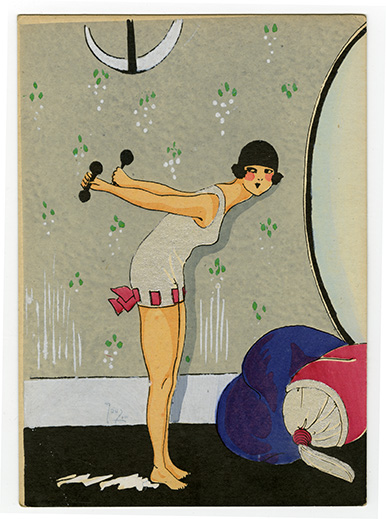
A time-travelling version of myself from the 1920s. (Illustration from La Culture Physique de la Femme Elégante, as posted here.)
Some non-empirical observations about this time period and set of data. I did not feel particularly hungry or like I needed food during this data period, even though I observably consumed fewer total calories and expended more. I found that I felt slightly overall more comfortable in my body: warmer in winter, cooler in summer, and generally more flexible (a bodily sensation I enjoy). (Other possible factors there: different clothing, different climate, different locations, the weird hyperbole/discounting of memories of past physical sensations.) Flipping through my logged workouts, my incremental increases in strength and endurance continue. One big difference between the logged data period and, e.g., graduate school, is that I don't really nap anymore. But there are enough other factors at play here --- my postdoc work schedule, French cultural conformity enforcing a standard and synchronized pattern of wake up-commute-work-lunch-commute-dinner, etc. --- that I have no idea if my food intake has had a causal effect on my decreased napping, or if other confounding factors have combined, or if perhaps I just aged into an adult sort of schedule which my body finds comfortable.

May your green trend ever upwards!


This post's theme word is overmorrow, "the day after tomorrow." Can your model predict how much I shall exercise on the overmorrow?

Wednesday, March 9, 2016

Extremely French

I was supposed to go to the opera to see Die Meistersinger von Nürnberg, a lengthy and high-cultural-value affair lasting 4.5 hours. It is an opera about master singers, and a comedy, so I was really looking forward to the auditory spectacle and the sheer delight. Very enlightened, very fancy, very grown-up and moved-to-Paris of me.

But.

There is a national strike today, over some new labor laws, which includes theater technicians. So the opera was cancelled because of a strike.

Even more French!


This post's theme word is inveigh, "to complain or protest with great hostility." The octogenarian-filled queue to exchange tickets at the opera was grumbly but did not inveigh.

Sunday, March 6, 2016

Video game art

An interesting and high-concept, fancy exhibit of video game art included swooping drops of tone down to doodles on the wall, including several featuring a very stupid rabbit (citation needed?) who goes on adventures, often of a fatal and pratfall-humor nature.

The squids, tentacly, badly lit in this awkward photo, and in a spaceship, were a favorite with me.

This post's theme word is quisling, "a traitor, especially one who aids an invading enemy." Is there any other kind?

Wednesday, March 2, 2016

Echopraxia

Peter Watts' Echopraxia is not so much a sequel to Blindsight as a sequentially-timed companion piece. The characters and locations are all different; weirdly, the only constant is the aliens (kind of), and since they are not identifiably individual/group entities and don't speak, I don't think it/they really count for story continuity.

As a companion piece, Echopraxia does well --- it maintains the balance of cool and weird ideas* with an engaging and unpredictable plot. The structure was eerily similar: a slow build of action and ideas, turning in a widening gyre, punctuated by a sudden flurry of violence, trailing off into chaos as things fall apart and the book ends. Anarchy is, of course, loosed upon the world.

Again, many elements of the book were pure bait to me.
But she wasn't letting it go. "Everything's numbers you go down far enough don't you know?" She poked him, pinched his arm. "You think this is continuous? You think there's anything but math?"
He knew there wasn't. ... Numbers didn't just describe reality, numbers were reality, discrete step functions smoothing up across the Planck Length into an illusion of substance. (p. 166)
This quote flung me out of Echopraxia and back to my forever-sustained reread of A Compact History of Infinity, whose prose about the continuum is pure joy.

Echopraxia didn't really stick the landing for me. The main character was often off-balance and uncomfortable, but I felt sympathy neither with his feelings, nor his situation, nor his ignorance, nor him himself, even though he was the most relatably-like-modern-humans character, and recipient of the (reader-oriented) explanations and gradual reckoning of ideas.

The ending was incredibly bleak and pessimistic, a sort of anti-engaging wrapper around all the neat ideas. A bushel over the light. Blindsight was about consciousness and neurons, but Echopraxia seems to be about religion and neurons, which is just not as interesting to me.

This book made me feel retroactively obsolete from the vantage of future observers. Meh. I do not especially recommend it.


This post's theme word is casuistry, "deceptive or excessively subtle reasoning, especially on moral issues." Sufficiently advanced rhetoric is indistinguishable from casuistry; we're too dumb to understand the necessary nuanced reasoning.

*thoroughly-cited in Real Academic Literature, adding a huge chunk to my nonfiction reading queue

Tuesday, March 1, 2016

Il trovatore

Verdi's Il trovatore is a... an opera. I wanted to write something like "a jolly operatic jaunt into the stereotyped gender-roles of yestercentury" but I don't think that my sarcastic tone carries through sufficiently. So I'll save "jolly" to describe operas which are nonironically jolly, pleasant romances and cross-dressing comedies.

This one is not that.

The music is gorgeous. The performers were excellent. (Several enthusiastic audience members audibly cried, "Bravo! Bravo!" after particularly emotive arias.) The staging was abstract and stark, which is not my favorite type of visual spectacle. The stage was a bare grey-brown rectangle, out of which a grid of vertical rectangular slabs could be lifted to various heights, surrounded on three sides by giant mirrors. The slabs were used to build the cells in a prison, or suggest a graveyard, or as military foxholes. It was a creative use of monochromatic 3D rectangles to portray a variety of settings. (See the slideshow here.) The costumes were mostly also a drab grey-brown, all military fatigues and gypsies wearing rags and dark overcoats. The blocking was rectangular and fixed, too, although this could just have been suggested and accentuated by the stage decorations. (My preference tends more towards staging, choreography, costumes, and sets which could be described as "lush", or "ornate", or magnificently "rococo.")

I loved the music.

I detested the plot. Its overarching theme, reinforced with every scene and sometimes every line in a scene, was that women are property, to be owned, punished, and exchanged by men. Booooo. It's a historical attitude, sure, and modern performances are literally restricted by the limits of the libretto. But still. Even within the plot, the female lead Leonora tries to use socially-acceptable techniques to control her fate (although not to own herself, never to own herself, remember: women are property, she can at most influence which man owns her). She tries to take vows at a nunnery and is interrupted by not one but two men (that cursed love triangle) who come to repossess her.

Lots of other plot crap happens. Read the synopsis if you like; it contains details that are so subtle that they are not even mentioned aloud during the opera, and YMMV based on the starkness and detail-paucity of your particular production. This is one of those plots where if all the characters could just sit down (unarmed) around a table and talk for 5 minutes (or maybe 45 if they're singing instead), the entire plot could be resolved, with no dramatic irony or tension or really much of a hassle at all.

Instead, everyone dies. (Well, almost everyone.)

There, I've spoiled it for you, as much as a 150-year-old opera which follows all the opera stereotypes can be spoiled. (Perhaps I've spoiled all operas for you: everyone dies at the end! Voilà!)


This post's theme word is makebate, "one who incites quarrels." Based on historical data, librettists tend to be inflammatory makebates: consider at how many duels, wars, fights, and poisonings they incite.

Monday, February 29, 2016

February retrobloggin'

What a cool day. I'm probably out enjoying my extra day by leaping from stair to stair, bridge to bridge, tower to tower. Possibly singing at the same time.

I'm chugging along, with Beeminder on my tail. This month I reduced the number of outstanding draft posts substantially, from 382 to... whatever 382 minus the bullets below is. Hopefully I didn't lose too much ground to new draft posts this month.
Most of the retroblogging seems to be processing and sorting photos that I intended to blog, but got caught somewhere in my camera, on a memory card, or on a folder on my desktop. (Helpfully, the folder is called "sort these".) So here, enjoy these captured photons of my past.


This post's theme word is rhadamanthine, "inflexibly just or severe." The Beeminder penalties for defaulting on personal goals become increasingly rhadamanthine.