Saturday, July 11, 2015

Stone-carving calligraphy

The stone monuments are decorated with beautifully-carved writing. Mostly they hew to the "traditional" style of character (rock pun!), the complicated-but-fixed one that I memorized off so many flashcards.

But sometimes they get to swoop into a different artistic style, with visible brushstrokes (carved) and some expressivity in the characters.
Probably if I could read these, I could come up with a context-driven explanation for why these characters are swoopy and scribbly. Or figure out what the characters are.
As it is, I just really enjoy the beauty of the monuments, and the crossed-media effort required to carve stone to look like brushed ink on paper.


This post's theme word is malapert, "boldly disrespectful." Obnoxiously malapert visitors are not welcome on the temple grounds.

Thatch texture

The edge-on view of this thatched roof reminds me of sphere-packing problems.
The roof belongs to a historical, preserved "retreat" of a retired (read: wealthy) samurai. The garden is quiet, contemplative, and very pleasant. Almost all the walls were on movable rails, even though each room was at a different elevation from its neighbors.

It was a hot, quiet day, and I was glad to sit in this historically-preserved house, look over the garden, and think my thoughts while trying not to move or sweat too much.


This post's theme word is cenobite, "a member of a religious order living in a monastic community." The monastery is very peaceful. #cenobite4life

Friday, July 10, 2015

Banal tourist photos

There's a reason many tourist photos come out so identically: there is simply one point from which the view is spectacular, serene, well-framed, with interesting visual aspects and a clear focus.

This is that view at the parks in front of the imperial palace. There's a cute little decorative pond with a tiny house (shrine? temple? landscapers' hut?) on an island in the center.

Then there's the Wes Anderson version: centered, dramatic, low on emotion but high on organizational satisfaction. Just some temple grounds I wandered through.

And of course the dramatic-sunlit corner of a roof.

Then the photos which look utterly unremarkable, but are quite memorable for the context and the memory that accompanies. Of course these are only interesting for the photographer. Thus, in the center of the city, when I turned and saw a single view with trees lushly carpeting the hill in the distance, I took a photo: because just outside the frame, there was a bustling cityscape. But this one view stood out as exceptional.

Of course this exceptional contrast is not evident in the picture, which only shows a boring roof and some trees.

This is the essence of tourist photography: interesting for the rememberer, and extremely mundane and poorly-executed scrolling for everyone else. Feel free to click over to that other tab that's making noise, now, I won't be offended.

Here's another roof, silhouetted against the sky.

Here are some prayer lanterns, next to a bamboo with wishes tied to its branches. This is what happens when I try to frame the photo to have a lot of interesting visual detail, without wasting space on the framing details.

This is The Photo. I'm standing in a place where thousands of people stand every year to take this exact photo. The photo looks calm, but only because the funnels for tourists corral them outside the frame of this exact viewpoint. The reflection is nice, too.
What this photo doesn't show is that it was in the high 90s F, with something like 90% humidity, and thus punishingly unpleasant weather. Serenity and peaceful contemplation were much further from my thoughts than shade and maybe icy beverages.

But it's a tourist photo, so you can't see that! It just looks peaceful. Look, how peaceful.


This post's theme word is animadversion, "the act of criticizing," or "an unfavorable comment." Widespread animadversion for vacation photo slideshows somehow does not stop their continued production.

Thursday, July 9, 2015

Valet umbrella parking

The hotel has an outdoor umbrella stand, with keys and numbered locks. It's like a bike stand, but for umbrellas --- neat, orderly, and solving a problem I'd never considered bad enough to need its own system. I suppose this indicates that there is some extremely rainy weather here.
I only experienced 98% humidity and its muggy heat. Rain would have been a relief.


This post's theme word is onomastics, "the study of proper names or of terms used in a specific field." I require an umbrella expert, I am not familiar with the applicable onomastics here.

Tuesday, July 7, 2015

Inside Out

The latest in Pixar's endless emotion-tugging animated films "for kids" (but with lots of material for grown-ups) is Inside Out, which tells the tale of a young girl whose family moves to San Francisco. The star of the film is "Joy", a personified emotion who lives in the girl's head, drives her via a space-shuttle-like control panel, and rallies the other emotions (Sadness, Disgust, Anger, and Fear) to create what somehow, inexplicably, emerges as a coherent personality.

The movie swaps between inside and outside shots, and if you'd like to see what the movie looks like without all the interior explanation, someone made that edit already. It's as jagged and uneven as you expect in a movie where most of the motivation and explanation is interior.

Inside Out seems to be doing parents a service. It provides a convenient metaphor for talking with children about emotions, and managing them. It makes emotions a personification separate from the child, and of course --- because it's a standard Pixar heartstring-puller --- the moral of the story is: it's okay to be sad sometimes. A useful message.

It's unfortunate that only five emotions got to be incarnate: joy, sadness, fear, anger, and disgust. What about love, pity, hope, wonder, patience, envy, courage? Why is joy the only positive emotion that made the cut? This is understandable from a plot-simplification direction, but unfortunate as a service-metaphor, since it mushes humor and delight and affection and every other positive feeling into one lump. (On the other hand, Amy Poehler is the personification of joy in real life, so the casting is perfect.)

Another quibble: the movie posits that one emotion is the captain, making executive decisions, and that this emotion is fixed and unchanging. This is fine for our main character, driven by joy, but is rather depressing when we skip into the mother's head and see that she is driven by sadness, or the father's head, driven by anger, and realize that this will always be the case. On the other hand, they present as normal-to-happy, functioning adults, so maybe the takeaway message is that, however your emotions are inside your head, you are still okay?


This post's theme word is cack-handed, "clumsy." The child's attempt to comfort came off as cack-handedly sweet.

Monday, July 6, 2015

Lengthwise koi pond

Here, in a skew view, is my window's prospect down onto the hotel koi pond.

The lush greenery is a visual feast but indicative of a general temperature and humidity that is summery at best and oppressive at usual-status-levels. This view is perfect because it could be taken from inside the hermetically-sealed bubble of air conditioning provided for arctically-acclimated non-locals like me.


This post's theme word is burke, "to murder by suffocation," or "to silence or suppress," or "to avoid or bypass." The muggy atmosphere burked my usual tourist's enthusiasm.

Wednesday, July 1, 2015

Heat wave

It's hot. I understand and endorse the Roman legions' decision to keep conquering north after this point; it's still too hot at this latitude, there must be a cooler spot somewhere on the continent; let's conquer that! Also, perhaps if we conquer far enough, we'll reach a country where air conditioning is invented, and not regarded as unhealthy.

There no air conditioning in my university building. HR sent an email advising that we visit public libraries, grocery stores, or movie theaters --- the  few locations with air conditioning. Certainly not work or home. Yesterday I found myself contemplating taking the (cooled) subway train to the end of the line and back, for the temperature control. My body has to be somewhere at every point in time, so I'd like to maximize the volume of time-space spent at a cooler temperature.

I got my hair cut. It helps shed precious BTUs. Apologies to Neal Stephenson.

I'll see you at the other end of this heat wave. Best of luck to us both.


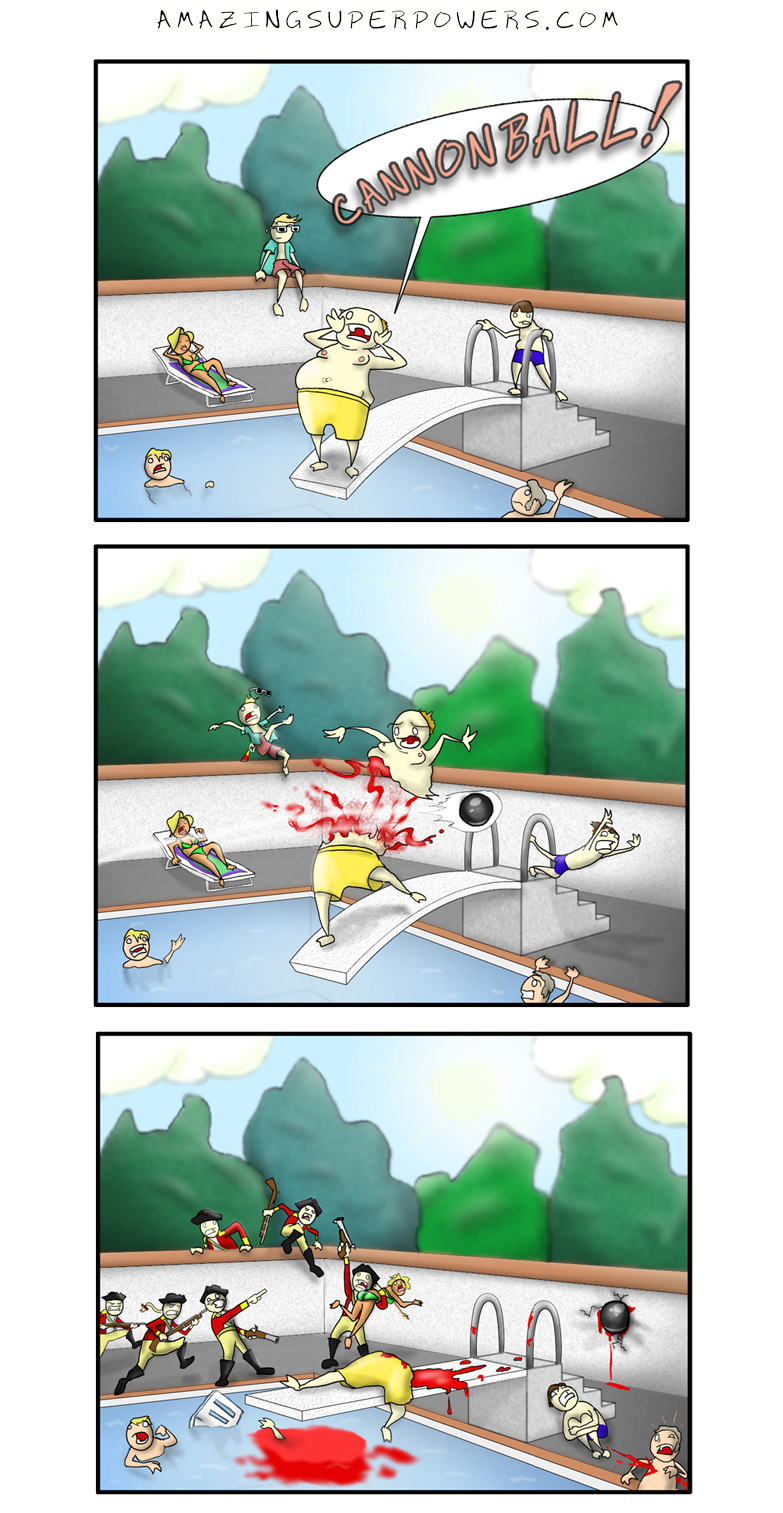
This post's theme comic comes from AmazingSuperPowers:
Just when you thought that a pool party would be perfect...

Monday, June 29, 2015

Manhood and the gender-parity inflection point

Ack. Here's an article on manhood, with many not-what-I-expected statistics that women are out-earning men, adapting to new social and economic standards, and leaving them behind. Yes, that's right.

It's interesting and befuddling that, in low-income settings, women are so outperforming (and outnumbering) men, while in high-income/status settings (the technology sector comes to mind, as well as higher education) women are discriminated against and an extreme minority. Is there an inflection point,* somewhere on the socioeconomic scale, where men and women have achieved parity?**

I recoil at the suggestion that school needs to be made more "boy-friendly", probably because every other article in my inbox is about how science education needs to be made more "girl-friendly". Dissonance! Although I am soothed by the author's explicit mention that suggested changes to the classroom are "all helpful, and all things that might be appreciated by girls, too."

The article jumps all around, from broad and depressing statistics to accessible anecdotes and prescriptive suggestions from Sweden***. The takeaway message was bafflement, and the unusual and welcome thought that my worldview had been slightly widened to include a world with the statistics and anecdata of this argument. I'm also puzzled why the article is  framed as if gains for women equals (necessitates, requires, produces) losses for men.**** Why must it be a zero-sum game of employment?


This post's theme word is inosculate, "to join or unite." It's intransitive. Who would want to inosculate home, health, and fate with an unpleasant, violent, ill-mannered, uneducated partner?


*An intermediate-value-wish like this one seems unlikely, because the statistics probably aren't dense enough to be continuous. Big discontinuities at: high school diploma, college diploma, parents' socioeconomic indicators, etc.

**On the one hand, I'd like to live at that point, where men and women are equally employed, equally caretakers, equally-represented, equally successful. On the other hand, I probably don't want to move down the socioeconomic scale to reach that point, if I am currently above it.

***This is the parallel of Godwin's Law for articles on issues of economy, family, employment, education, health, or any other aspect of society: the article will, eventually, hold up Sweden as an example.

****On the other hand, the article illustration of a see-saw has a man on one side and no one is playing with him on the other side; yet he is still, inexplicably and in defiance of physics, up.

Friday, June 26, 2015

One Bright Star to Guide Them

In many novels, the plot reaches a point where the main character(s) must explain everything that has happened so far to a new character who is unfamiliar with the plot. Usually it happens like this: "Then Mary-Sue told Robert about the entire adventure,  focusing on important plot details X and Y. 'Wow!'  Robert said, 'Let me help you achieve Z!'" That is, the novel usually excuses the novel-reader from re-reading a description of the previous chapters of the novel.

"One Bright Star to Guide Them" by John C. Wright consists almost entirely of characters reporting what has just happened. Sometimes the action chapters are themselves excluded from this novella (another 2015 Hugo nominee), so that one chapter of a character summarizing action can be followed by another chapter of the same character summarizing the actions he did after the last time he summarized them.

This is torture to read. It's a novella, but it took me several weeks to force my eyeballs across all the pages. A torturous horror, an affront to the literate English-reading portion of the world's population.

What, in particular, was bad? Aside from the lack of action, the prodding prose, and the completely shallow and unengaging two-dimensional hero and villains? Those elements alone certainly made this an atrocious nominee. In addition, the author at various points demonstrates a baffling lack of knowledge about basic things, like: how boats work, basic anatomy, and physics.

Outward appearance exactly mirrors standing on the good/evil axis: "good" characters and items are infused with light, warmth, intelligence, honesty, truth, Capitalized Nouns, and well-tanned muscular good health; "bad" characters and items are dark, black, shadowy, gaunt, hollow-eyed (oh, so hollow-eyed!), hunched, draped in black robes, blind, lying, devious, clever, evil, and unhealthy. Nothing plot-relevant combines traits from both lists; good is turned up to 11, and bad is turned up to 11, and the entire story careens madly from 11 to 11, with no smaller integers available. The laziest sort of storytelling and symbolism, relying entirely on stereotypes, abounds. The level of diction ranges from painfully "street"-wise to archly ornate, often within the same sentence, although overall the story tends to be written as if it is Bible verse (which is to say, has been translated through many languages with no care for the fluid readability of the resulting sentence). The author cannot decide if the main character is "Thomas" or "Tommy", even within a single paragraph. Overall, the prose is so stiff it is mentally painful to read.

After the hero achieves his objective (defeating Evil on Earth! not bad!) and Catholically feels guilty rather than relieved, the (sigh) expected god figure (basically Aslan) descends from on High to make the hero feel a little better. This talking, golden-light-exuding giant lion gives all kinds of Good News about redemption, future heaven awaiting, etc.... and inexplicably mixes in some bits about how terrible suffering also awaits some of his Good friends, the main character accepts all this news (wretched future suffering!) with a Glad Heart, and so on. Elsewhere in better literature, Gollum is also stolen to appear in one (largely expository) scene, then be immediately defeated.

At some early point, I added a margin note that "all this summarizing had better be a joke, or else this story is a garbage attempt at an outline of a novel." Unfortunately, the entire story was straight and no ironic wink waited at the conclusion to acknowledge the horrible, trite sentences, the boring tropes, the unexciting fight scenes, the painful non-scanning rhymes which were necessary to do any Good Magic.

In conclusion: yuck.


This post's theme word is obtest, "to invoke as a witness, to implore, to beseech" (transitively), or "to protest, to plead" (intransitively). I obtest thee, read not this abominable collection of concatenated sentences.

Saturday, June 13, 2015

A giant mobile brush?

I guess it's art, but my imagination is reaching for a use-case for this giant metal brush on a tripod of wheels.
Somewhere, there is a giant who wants to clean underneath his toenails and is sorely disappointed by the lack of this tool.


This post's theme word is filipendulous, "hanging by a thread." Some artworks derange the viewer until sanity is filipendulous.